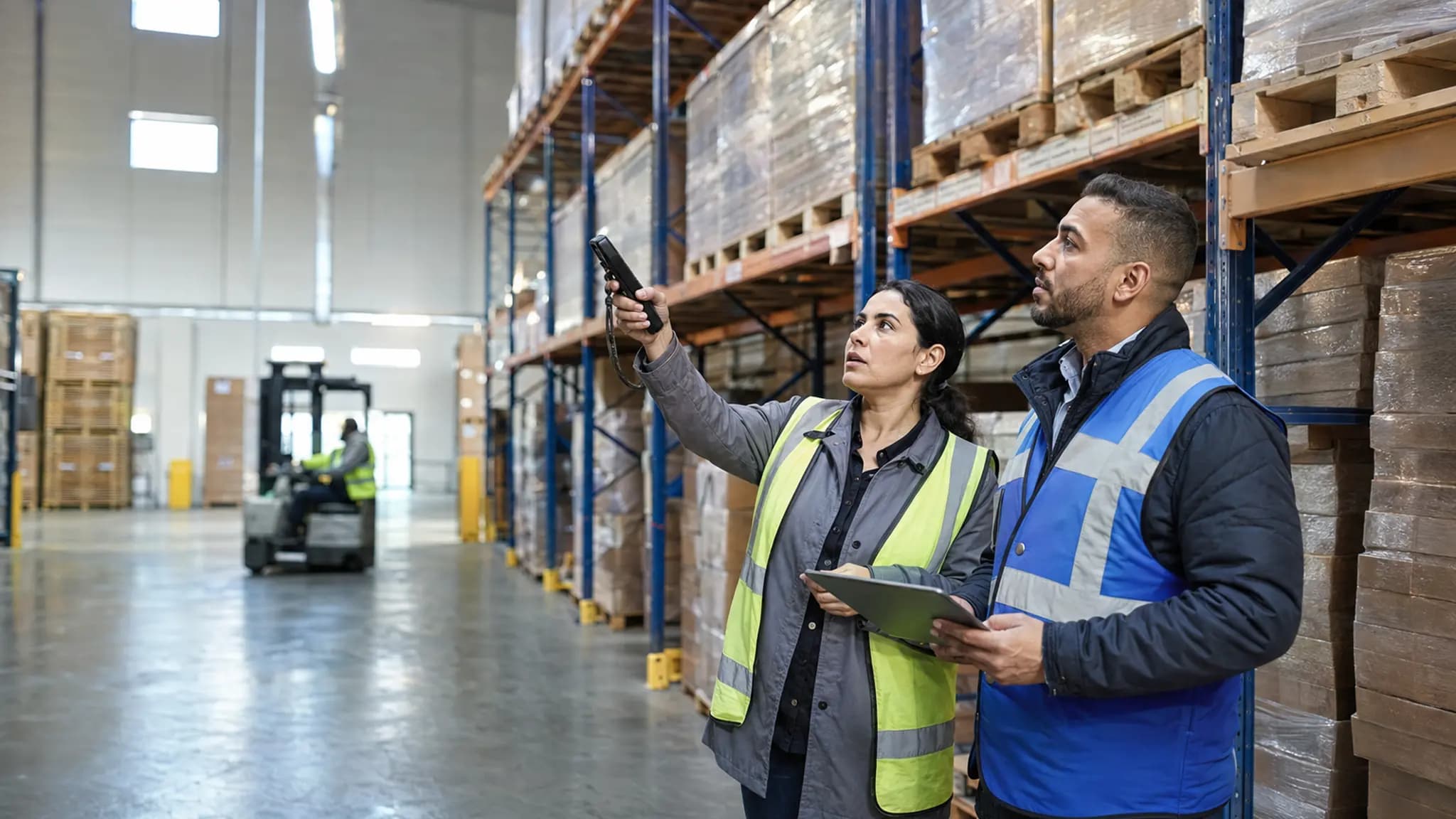
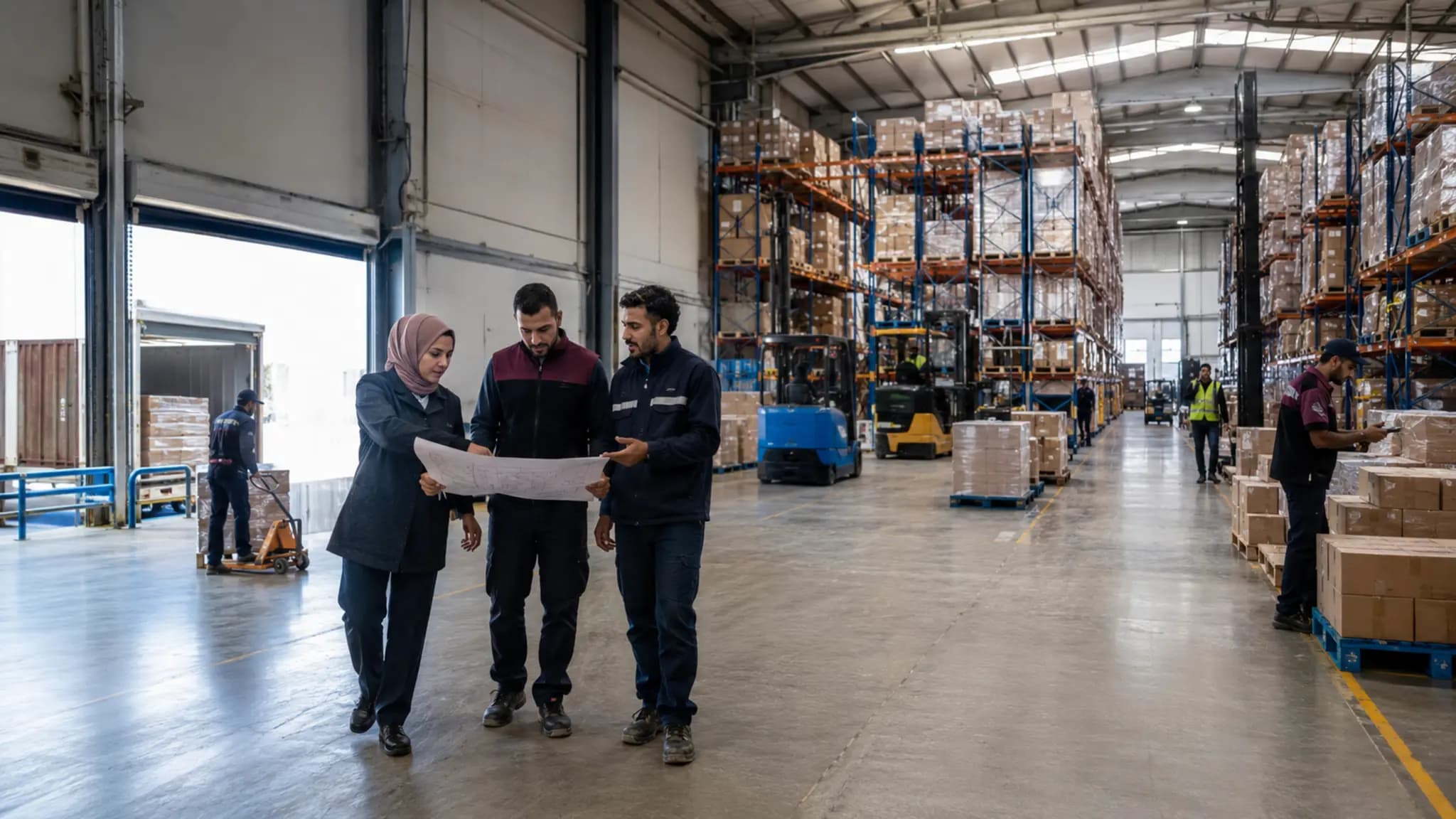
One sheet, one situation, one line of reasoning to practise.
Intended for logistics courses, engineering and business schools, and teams onboarding new colleagues. It follows the ‘Warehouse fundamentals’ series and can be read independently.
Each sheet follows the same structure: a situation, the reasoning needed to interpret it, common mistakes and an exercise with no single correct answer. The common thread is a simple idea: at every stage, an error costs more than it did at the previous one. Understanding this gradient means understanding why operations are organised as they are.
Sheet 1 — Receiving: the only time when an error costs little
The situation
A truck arrives. Twenty pallets are unloaded. The warehouse operator compares them with the delivery note, signs it, and the truck leaves.
The scene lasts twenty minutes. What happens there affects the following weeks.
The reasoning
Receiving is the entry point for all warehouse information. Anything recorded incorrectly here will be wrong everywhere else until someone discovers it — and discovery always comes at the worst possible time.
A receiving error costs a few minutes if detected immediately. The same error found during picking costs an incomplete order. Found by the customer, it costs a dispute. Found during a stocktake, it costs nothing more to correct, but no one will ever know where it came from.
That is why receiving deserves more rigour than it usually gets. It is seen as an administrative formality; it is the moment when the warehouse determines the quality of its own information.
There are three distinct checks, and they are often confused:
Quantity check — does the number of units match what was announced?
Quality check — condition, compliance and specific attributes (batch, date, temperature).
Document check — are the mandatory documents present and compliant?
A product may comply on two of these dimensions and be blocking on the third.
Common mistakes
Signing the delivery note before counting because the driver is in a hurry. Once signed, disputing it becomes difficult.
Checking the announced number of cases without checking what is inside them.
Recording the receipt in the system several hours after unloading. In the meantime, the stock exists physically but not digitally.
Failing to handle a partial delivery: what happens to the outstanding quantity, and who follows it up?
Exercise
Take a real or imagined receipt. List everything that should be checked. Then mentally time each check and add the times together.
Compare this with the time actually available when three trucks are waiting.
The question you have just encountered is the real receiving question: what do you check when you cannot check everything? The answer is not ‘everything’; it is ‘what will cost the most if discovered later’.
Sheet 2 — Putaway: storing is a decision
The situation
A pallet is received. A forklift operator takes it and puts it away. The action appears trivial.
Yet it contains a choice that will determine the cost of every future pick for that item.
The reasoning
A location is not an empty space. It is a position on a route.
The picker who comes for this product will make a journey. That journey will be repeated as often as the product is ordered. An item dispatched fifty times a day and stored at the back of the warehouse costs fifty daily round trips; the same item at the front of the aisle costs no more travel than necessary.
This is called slotting — assigning products to locations according to their dispatch profile. The basic principle fits into one sentence: the most frequently requested products must be the most accessible.
But other constraints conflict with this principle, which is what makes the subject interesting:
Weight. Heavy products go at the bottom, for safety and ergonomics.
Compatibility. Some products cannot be stored together for health, odour or regulatory reasons.
Temperature regime. It imposes a zone regardless of turnover.
Volume. A bulky, infrequently requested item will nevertheless occupy an accessible location when there is no alternative.
Picking coherence. Grouping products frequently ordered together reduces travel more effectively than classifying each one separately by turnover.
Slotting is therefore a trade-off, not a rule. And like every trade-off, it becomes outdated: a bestseller becomes residual stock, while a new product takes off. Slotting unchanged for three years is wrong slotting.
Common mistakes
Putting stock ‘where there is space’ without a rule, making picking routes random.
Never reviewing slotting. Product turnover changes; the layout remains.
Optimising storage density at the expense of accessibility. A very dense warehouse is a slow warehouse.
Leaving pallets in the receiving area because no location is available — this is how stock that cannot be found is born.
Exercise
Imagine a warehouse with one hundred items. Ten of them account for most dispatches.
Observe how your initial layout becomes distorted. You have just reproduced, on a small scale, the work of an operations manager.
Sheet 3 — Picking: where the work happens
The situation
In most warehouses, order picking accounts for the dominant share of working time — more than receiving, putaway and shipping combined.
It is therefore the stage where every improvement has the greatest effect and every complication costs the most.
The reasoning
Picking an order means following a route while collecting products. Time breaks down into three parts:
travel — the largest share in most operations;
the pick — taking the product, counting it, putting it down;
ancillary operations — reading, validating, labelling and searching.
Organising picking is essentially about reducing the first share without increasing the other two.
There are four main methods, and the choice depends on the order profile:
Order by order. One picker, one order, one route. Simple, with no risk of mixing, and suited to large, low-volume orders.
Grouped. A picker collects several orders in one route, then separates them. Far less travel, but it adds a sorting stage that must be reliable. Suited to many small orders.
By zone. Each picker covers one zone; the parts of an order are then consolidated. Effective in large warehouses, but requires synchronisation.
By wave. Groups of orders are released according to an external constraint — a route’s departure time or a channel’s cut-off. This is the method that connects the warehouse to transport.
These methods can be combined. The same warehouse may use grouped picking for its small-order channel and order-by-order picking for large customers.
Common mistakes
Choosing a method by imitation without examining the actual order profile.
Ignoring the cost of sorting in grouped methods. It is invisible in theoretical calculations and very real on the floor.
Failing to define what happens when stock is missing. This is the most common situation in picking, and the one that most often leaves the picker to decide a commercial matter alone.
Multiplying intermediate checks until checking costs more than the error it prevents.
Exercise
Take two order profiles.
Profile A: 40 orders a day, 60 lines each, bulky products.
Profile B: 900 orders a day, 2 lines each, small products.
For each one, choose and justify a picking method. Then estimate what happens if volume doubles.
You will find that the optimal method for one is disastrous for the other — and that doubling sometimes changes the answer.
Sheet 4 — Checking and shipping: the final filter
The situation
The order has been picked. It is checked, packed, labelled and loaded.
This is the last opportunity to detect an error at internal cost. Afterwards, the error becomes a dispute.
The reasoning
Checking raises a simple economic question that is rarely asked explicitly: how much does the check cost, and how much does the error it prevents cost?
Checking one hundred per cent of orders is reassuring and often unreasonable. Checking zero per cent is risky and sometimes justified. Between the two are several strategies:
Sampling — a randomly selected proportion of orders.
Targeted — complex orders, sensitive customers and high-value products.
By weight — comparing actual weight with theoretical weight. Fast, and able to detect a large share of quantity errors.
Systematic during the first days of a new customer or process, then reduced.
The guiding principle is that the check must be proportionate to the cost of the error, not its probability. An error involving a pharmaceutical product and one involving a mass-market product do not call for the same level of verification.
Shipping adds a dimension that picking does not have: contractual commitment. What leaves is accompanied by authoritative documents. A signed delivery note, a consignment note, a customs document. These documents are not administrative: they prove what you did and will determine the outcome of any dispute.
Common mistakes
Having the picker check their own work. Attention does not detect its own mistakes.
Checking everything for a long time without ever measuring the actual error rate — and therefore never being able to reduce checking.
Neglecting to verify the number of units actually loaded. This is the last point at which a variance can be detected for free.
Letting goods leave without confirming shipment in the system. The stock then remains present digitally after it has physically left.
Exercise
A warehouse ships 500 orders a day. A check takes 90 seconds. An error detected by the customer costs, all told, the equivalent of one hour’s work plus a commercial concession.
Estimate the cost of checking every order. Then calculate the error rate above which it becomes worthwhile.
You will obtain a threshold. The next question is the most important: do you know your actual error rate? In most operations, the answer is no — which is why the level of checking is decided by intuition rather than calculation.
Sheet 5 — Returns: the unplanned flow
The situation
A customer returns goods. They arrive at the warehouse without notice, sometimes without documents and often in damaged packaging.
Where do they go? Who decides what happens to them? Within what time?
In many warehouses, the answer to all three questions is: ‘in a corner, later, someone’.
The reasoning
Returns are the only warehouse flow that cannot be planned — no one knows when they will arrive, in what quantity or condition. That is why they are structurally mishandled.
Yet the flow follows a clear four-stage logic:
1. Receiving the return. It must be linked to something: an original order, a customer, a reason. An unlinked return is unmanageable — no one will know whether it is legitimate or whether to issue a credit.
2. The decision. There are four possible outcomes, and only one will be right: put back into stock, refurbish, downgrade or destroy. The decision depends on condition, product and sometimes regulation.
3. Executing the decision — with its stock and value consequences.
4. Commercial settlement — credit, replacement or rejection. It depends on the previous decision and must rely on the same information.
The critical point is the second: decision time. Without a written maximum, the returns area grows indefinitely. It is one of the most visible symptoms of an operation without rules, and one of the easiest to correct.
Common mistakes
Automatically putting a return back into saleable stock without checking. This reintroduces damaged or expired products into the normal flow.
Mixing returns awaiting a decision with available stock. Stock becomes inaccurate, and the next order will receive an unreleased product.
Failing to record the return reason. Yet it is the only source of information about picking, packing or product-description faults.
Treating the return as a purely logistical issue when the decision is commercial.
Exercise
Describe the return process in an organisation you know, or imagine one. For each stage, answer three questions: who acts, within what time and with what record?
Then identify the stage at which the process most often stops.
In most cases, it is the decision. Not through negligence, but because no one formally has the mandate to make it. This is an organisational problem, not a logistics problem — and the same is true of many problems blamed on the warehouse.
Going further
These five sheets describe a warehouse as a sequence of stages. This is a useful simplification for learning and inaccurate in practice: in a real warehouse, all five flows happen at once and compete for the same resources and docks.
This simultaneity is what makes the work difficult, and no educational sheet can reproduce it. It is learned on the floor on a busy day.
This series is freely available for educational purposes. It may be reproduced in a training context with acknowledgement of the source.