Connect product exposure to continuity evidence.
The source content is reorganised into readable sequences: context, trade-offs, checklists and data structures.
- 22
- chapters
- 22
- minutes
- 4
- markers
Four markers that keep the decision in view.
- 01Exposure
- 02Rule
- 03Traceability
- 04Response
A chain is only as strong as its weakest link, and that link is almost always the same
A cold store is a major investment, monitored and fitted with alarms. A refrigerated truck is equipped, checked and maintained. Both work correctly most of the time.
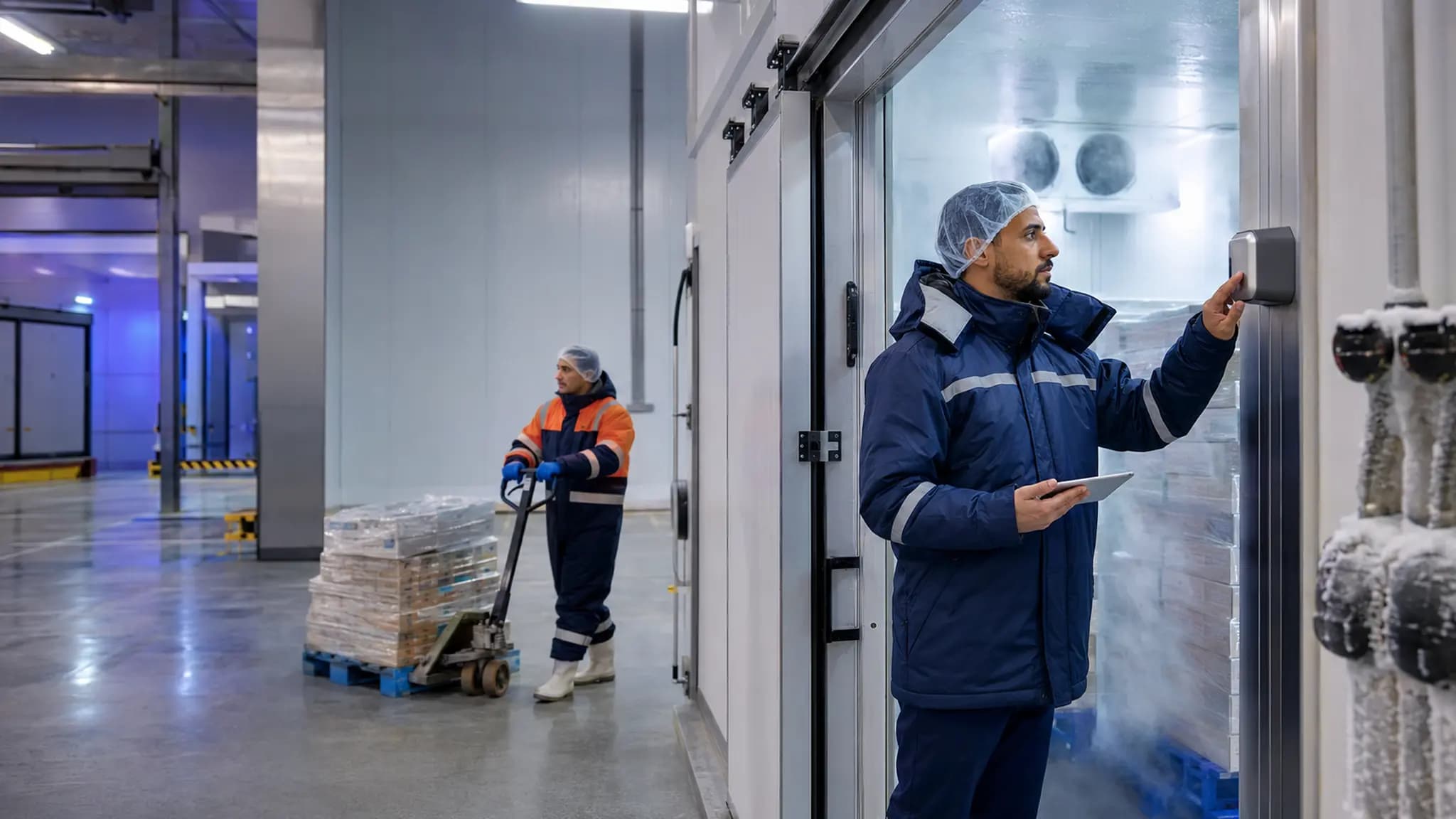
Between the two is a dock. A door opens, a pallet waits, a driver looks for a delivery note, and a dock lift takes eight minutes.
That is where the chain breaks, and it is the only place where no one measures anything.
This document treats thermal continuity as an information problem before an equipment problem. It is intended for multi-temperature warehouses, cold-chain providers, food and pharmaceutical distributors, and temperature-controlled carriers.
PART ONE — WHAT WE MONITOR AND WHAT WE DO NOT
The difference between temperature and exposure
A cold room displays a temperature. It is recorded, often continuously, sometimes archived for years. Everything looks fine.
What this measurement does not say is what the product experienced.
A case may have spent forty minutes on a dock at ambient temperature before entering the cold room. The room saw nothing. Its record is perfect. The product, however, underwent an exposure that appears nowhere.
This is the central distinction in this document:
- Enclosure temperature — measured everywhere, archived everywhere and rarely problematic.
- Product exposure — what the product actually experienced from supplier to final customer. Almost never reconstructed.
A complete quality file contains the first. Genuine control requires the second.
The five moments of exposure
They are few, known to everyone and rarely instrumented.
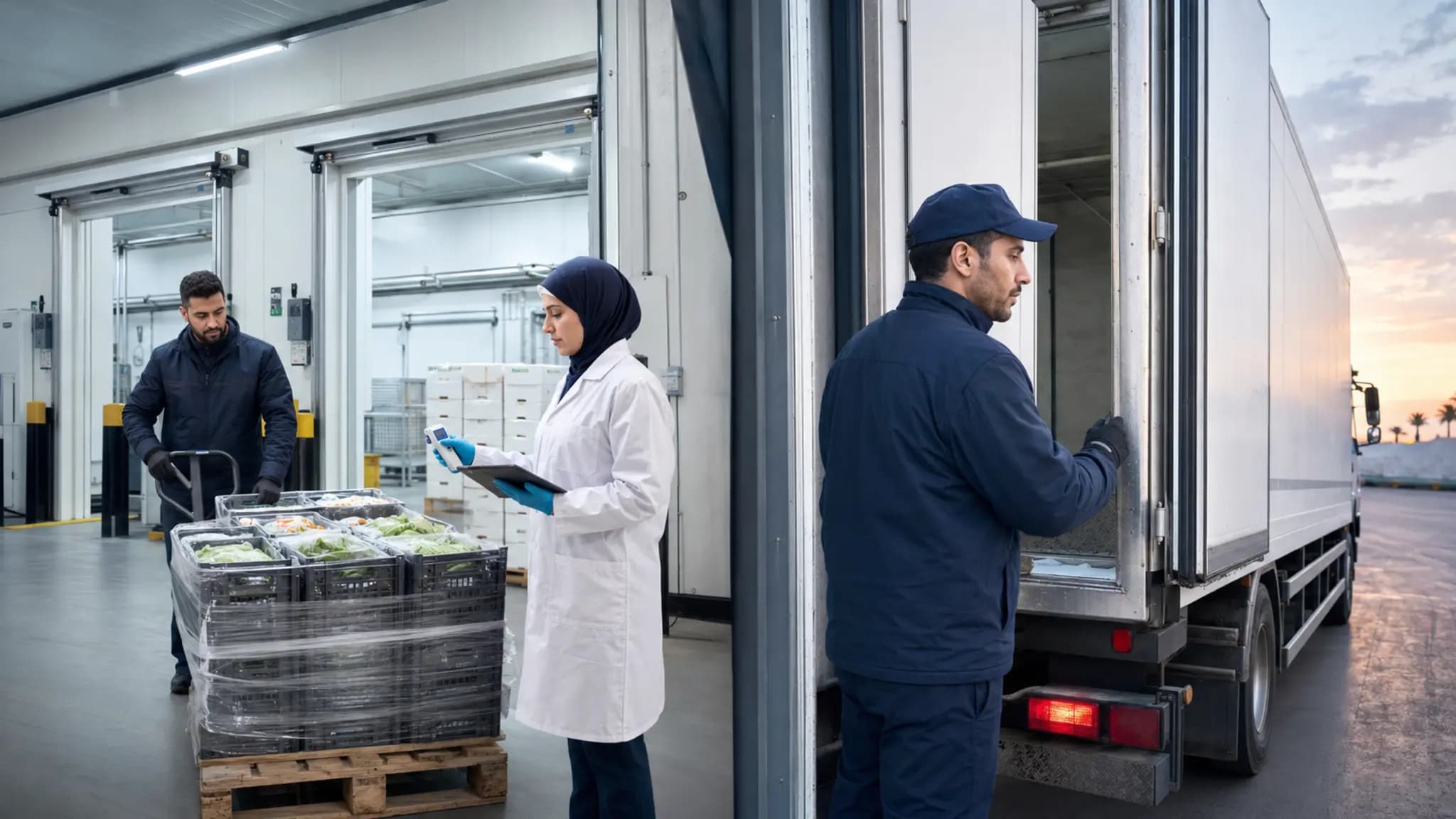
1. Receiving. Between opening the truck doors and putting the product into cold storage. Typical duration: from a few minutes to more than an hour, depending on dock organisation and handling-equipment availability.
2. Transfers between zones. A product moving from frozen to chilled storage, or from a picking area to a shipping area, sometimes crosses unregulated spaces.
3. Picking. Time spent at a picking station, in a buffer zone or on a load carrier awaiting inspection. For multi-temperature orders, this is the most critical point: a mixed pallet inevitably waits somewhere.
4. Loading. The pallet is ready, but the truck is not yet at the dock. This is the weakest link in the chain in most operations we know.
5. Delivery. Opening the doors at the customer, unloading and transfer to its own storage. A shared exposure zone with unclear responsibility.
The exercise to do this week
It costs nothing and teaches more than any audit.
Take a stopwatch. Follow three pallets from the truck to the cold room. Record the actual time between opening the doors and putting the goods into cold storage. Do it at three different times: on a quiet morning, on a busy receiving day and on a Friday afternoon.
You will obtain three figures. The difference between the first and the third is your real issue.
PART TWO — THE INFORMATION STRUCTURE
A temperature-controlled product has several identities
In an ambient warehouse, an item is an item. Under temperature control, it has several attributes that determine everything:
01Attribute What it determines
02Temperature regime Permitted storage zone, transport compatibility
03Batch number Upstream and downstream traceability, potential recall
04Expiry date Dispatch sequence, alert threshold, downgrade decision
05Health status Released, pending, blocked, to be destroyed
06Origin / certificate Documentary obligations by product and destination
These attributes are not nice-to-have information: they are management rules. A system that stores them without making them act is useless.
Three examples of rules that must be automatic:
- a customer order cannot allocate a batch whose remaining shelf life is below that customer’s contractual minimum;
- a location in a given zone accepts only products with a compatible temperature regime;
- a blocked batch is never proposed for picking, even if it is the oldest.
If any of these rules relies on an operator’s vigilance, it will fail on a busy day.
Minimum shelf life on receipt
Many contracts overlook this point, and it causes costly disputes.
A retail customer, exporter or wholesaler often requires a minimum proportion of the product’s shelf life to remain at delivery — expressed in days or as a percentage. Delivering a compliant product too close to its expiry date means delivering a rejection.
This requirement must exist as data, by customer and product family, and be applied when stock is allocated — not during checking, when the pallet has already been built.
This is a typical case where a simple rule applied at the right time eliminates an entire category of disputes.
PART THREE — MULTI-TEMPERATURE ORDERS
The problem created by a single pallet
An order contains frozen, chilled and ambient products. The customer expects one delivery, not three.
It must therefore be picked in three different zones at three different times, then consolidated. And consolidation involves waiting.
Four strategies exist, with different compromises:
Sequential picking, from coldest to least cold. Start with frozen and finish with ambient. Simple, but the frozen goods wait the longest — exactly the opposite of what is needed.
Reverse sequential picking. Finish with frozen, which goes straight to loading. Better thermally, but more demanding operationally: it must be synchronised with the truck’s actual departure time.
Temperature-controlled buffer zone. A consolidation area at an intermediate temperature. Costly, effective and reserved for volumes that justify it.
Separate load carriers. Each temperature regime travels on its own carrier and they are consolidated only in the truck. The safest thermally, but the most demanding in loading space.
There is no universally correct answer. Each operation has an answer that depends on mix, volume and fleet. What matters is that the answer is chosen and written down, rather than endured.
Sequencing is an information issue
Whichever strategy is chosen, it requires the system to know the sequence in which to release picking waves, based on the planned departure time of each route.
This often-underestimated point marks a fundamental shift: multi-temperature sequencing is not a warehouse setting; it is coordination between warehouse and transport. If they do not share the actual departure time, sequencing is impossible.
PART FOUR — TRANSPORT
Load compatibility
A dual-temperature vehicle is not a vehicle that can carry everything. It has compartments, fixed or movable volumes and compatibility rules between products.
The system building the loads must know three constraints:
- capacity by compartment, in volume and weight;
- the temperature regimes each compartment can maintain;
- health-related or odour-related incompatibilities between product families.
Without this data, loads are built from experience — which works as long as the experienced person is there.
Proof of temperature at delivery
A temperature-controlled delivery may be disputed on two points: temperature on arrival and product condition.
Useful evidence brings together four elements: a dated reading, a photo if necessary, the recipient’s signature, and a link between all of these and the job and customer.
What is almost always missing is not the reading — it is the link. A photo taken on a phone and sent through a messaging app is not evidence: it is a memory without a case file.
Reservations
A recipient raising a reservation must be able to do so at delivery in a usable form. A handwritten reservation on a delivery note that returns on Friday will not be processed in time.
For sensitive products, the rule that changes everything is this: a reservation triggers an immediate alert, not a line in a weekly report. Some decisions cannot wait — accept, reject, isolate or destroy.
PART FIVE — THE CRISIS
The only test that matters
Every traceability system must answer one question quickly and under pressure:
Batch number X is suspected. Where is it?
A complete answer has four parts:
- What remains in stock, and precisely where.
- What was shipped, to whom, when and in what quantity.
- What is being picked or is in transit.
- What was used as a component, if you process or assemble products.
The acceptable time depends on the product and sector — but in every case it is measured in minutes or hours, never days.
The dry run
Run it once a year. Choose a batch at random, launch the search and start the clock.
There are three possible outcomes:
- Under one hour, with a list of recipients: your traceability works.
- Half a day, involving several people: it exists but depends on individuals. One departure or holiday, and the time doubles.
- More than a day, or an incomplete answer: you do not have traceability; you have archives.
This exercise has an additional benefit: it reveals breaks in the documentary chain. Most often, traceability stops when the goods leave the warehouse because transport is not connected.
Blocking
It must be possible to block a suspected batch immediately and everywhere: in stock, allocation, picking and pending shipment.
This function appears simple and is demanding in practice, because it assumes that every stock status is maintained by the same system. A block that does not apply to already allocated orders blocks nothing.
SELF-ASSESSMENT GRID
01Yes No
02Do we know the ☐ ☐ actual time between opening a truck and putting goods into cold storage?
03Is this time also ☐ ☐ measured on busy days?
Is temperature regime ☐ ☐ a product attribute that determines locations?
Are batches and dates tracked in stock, not only at receiving?
Does the minimum date required by each customer exist as data?
Is it applied when ☐ ☐ stock is allocated?
Do we have a written ☐ ☐ strategy for multi-temperature orders?
Does the warehouse know ☐ ☐ the routes’ actual departure times?
Is delivery evidence ☐ ☐ automatically linked to the job?
Does a reservation at ☐ ☐ delivery trigger an immediate alert?
Can a batch be blocked ☐ ☐ everywhere in one action?
01Have we timed ☐ ☐ a recall exercise in the past twelve months?
02Ten ‘yes’ answers or more: your control is genuine. Your scope for improvement lies in measuring product exposure.
03Between six and nine: the foundations are in place; continuity between warehouse and transport is probably your break point.
04Five or fewer: start with the stopwatch exercise and the recall dry run. They cost one day and will guide everything else.
05To conclude
06The cold chain is a field where investment in equipment is done well and information is often a generation behind.
07A warehouse can have impeccable cold rooms, recorders everywhere and flawless monthly reports — yet be unable, at three o’clock on a Tuesday afternoon, to say where the twelve pallets from a suspected batch went.
08The difference between the two situations is not a matter of resources. It is a matter of continuity: does the information follow the product from supplier to customer without getting lost at every handover?