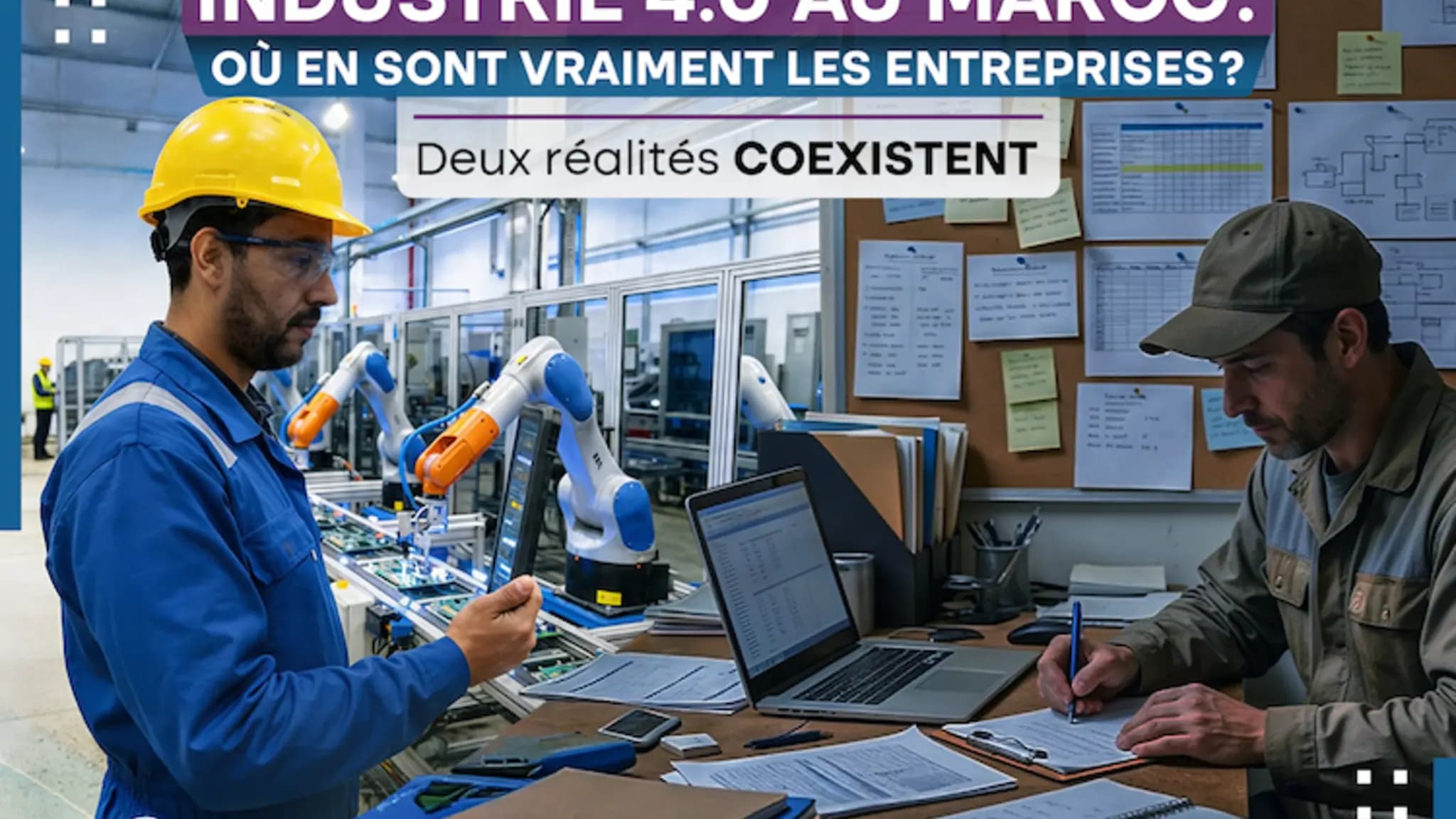
Two worlds coexist
Morocco's industrial landscape is marked by a striking contrast.
On one side are the country's leading exporters.
Automotive, aerospace and electronics: under pressure from European and Asian clients, these sectors have had to adopt high-performing digital tools. MES (Manufacturing Execution Systems), WMS (Warehouse Management Systems), predictive maintenance, lot traceability... their factories are often aligned with international standards. Data flows there in real time, decisions are guided by indicators and the supply chain is integrated.
On the other side is a network of SMEs that are still discovering the fundamentals.
Many of them manage production with Excel, maintenance with sticky notes and their warehouse with paper forms. Digital technology is often seen as an additional cost rather than a competitiveness lever. Teams lack the time to train, and management is reluctant to invest without visibility into the return on investment.
Why is this divide dangerous?
Global competition makes no distinction between a large exporting company and a local SME. Customers, whether industrial buyers or individuals, now demand:
- Transparency: where is my order? What are the lead times?
- Traceability: where do the raw materials come from? Which lots were used?
- Responsiveness: in the event of a shortage or a change in demand, can you adapt within a few hours?
Companies that still operate on instinct, using outdated data, quickly fall behind. Their hidden costs (scrap, unplanned downtime and excess stock) erode profitability. Their ability to respond to international tenders is consequently limited.
Barriers to digitalisation (and how to overcome them)
Several obstacles recur in our discussions with Moroccan manufacturers:
1. Perceived cost: "Investing in an ERP or MES is expensive."
In reality, scalable solutions make it possible to move forward in stages. A well-established first building block is better than a grand theory with no action.
2. Lack of expertise: "We don't know where to start."
Partners such as B-AGILE provide support from defining the need through to team training. People remain at the centre.
3. Fear of complexity: "Our processes are too specific."
Modern platforms can be configured and adapt to the reality of the workshop, rather than the other way round.
Accelerators: nearshoring and customer requirements
Nearshoring is putting Morocco back in the spotlight. European groups are seeking to shorten their supply chains and view our country as a strategic partner. But they make no concessions: before outsourcing production, they audit the subcontractor's digital maturity. Being competitive in 2026 means being able to share data in real time.
Conversely, SMEs that successfully digitalise will not only be able to respond to these tenders, but also improve their internal efficiency: less waste, better customer service and more valued teams freed from low-value tasks.
Where do you stand?
Digital transformation is not a sprint; it is a journey. Some companies have already taken the step, while others are still considering it. The important thing is to begin, even modestly, with a clear vision and strong partners.
At B-AGILE, we support Moroccan manufacturers—from SMEs to large groups—as they increase their digital maturity. Our solutions (industrial ERP, WMS, TMS, CMMS and CRM) are designed to adapt to your pace, without abrupt disruption.
👉 Would you like to assess your level of maturity or discuss your project?
Contact us for a no-obligation discussion.