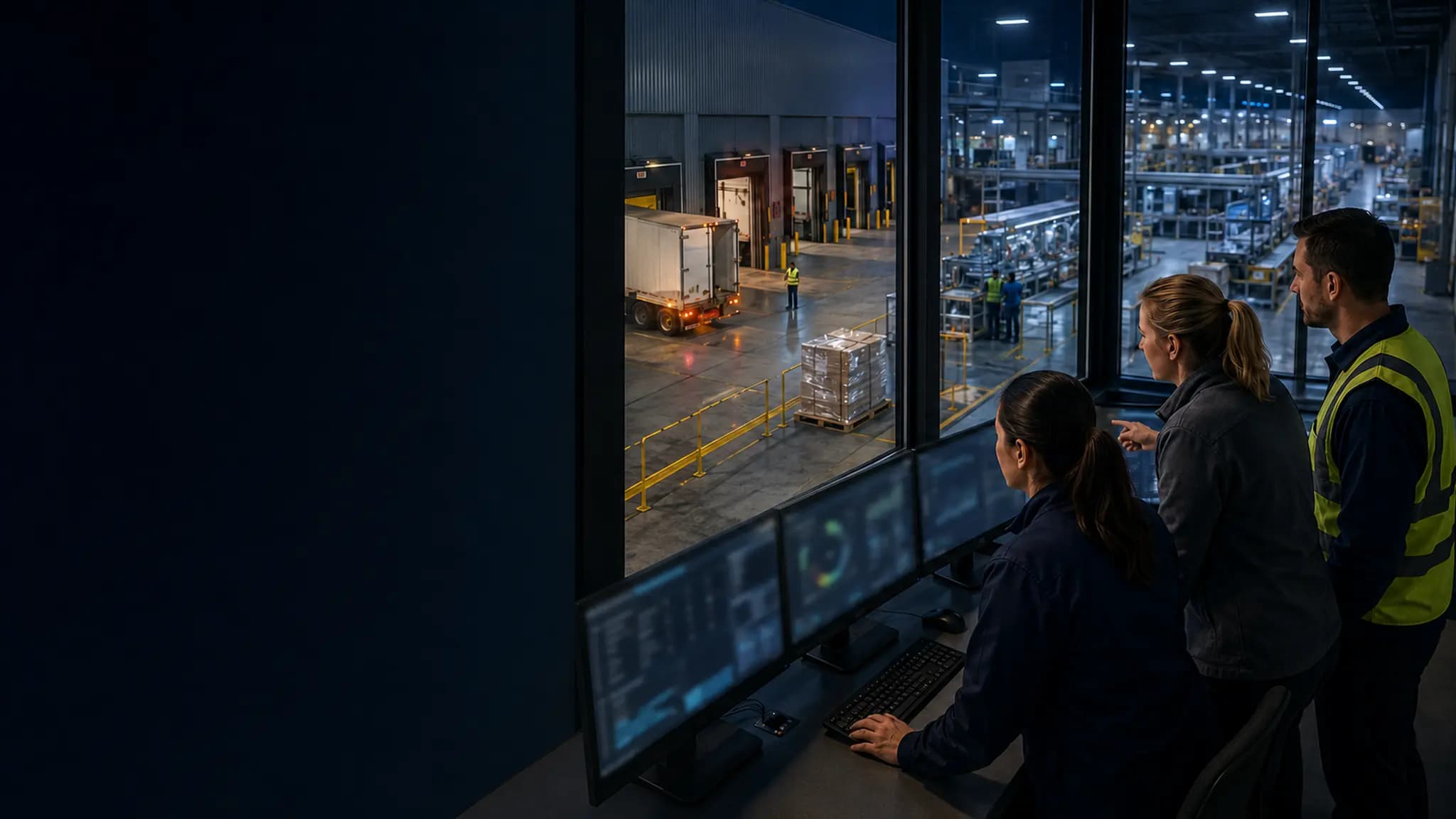
Realistic plan
Transport uses the real state of picking, docks and capacities.

Capability · Unified transport & distribution
Connect order, allocation, picking, dock, route, delivery, proof and cost in one flow, without blurring each system’s responsibility.
A capability shaped by your flows, rules and field evidence.
Transport uses the real state of picking, docks and capacities.
Operations, customer and partners share understandable milestones.
POD, reservation, return and document remain attached to the correct record.
Planned service is compared with what was actually executed.
Decision framework
Unification does not mean one system does everything. It means each relay receives the right event, makes its decision and returns usable proof.
Gaps to eliminate
Each gap connects an observable situation to a business consequence. Diagnosis then verifies frequency, impact and cause.
TMS plans without knowing whether goods or dock will be ready.
Waiting, replanning and extra costOrder, shipment and mission use different identifiers and milestones.
End-to-end view rebuilt manuallyCarriers, drivers and customers communicate by email or phone.
Late decision and scattered proofBilling, dispute and cost cannot retrieve actual execution.
Margin and service hard to explainOperational journey
Each transition identifies the participant, responsible system and expected proof.
Demand
Allocation
Picking
Transport plan
Execution
Close
Decision lab
These scenarios are illustrative: they show decision logic and responsibilities without claiming to simulate your actual outcomes.
Long-haul transport
Transport slot is firm but picking is slipping.
Reprioritise the wave or reassign the slot based on customer impact.
New decision shared by WMS, TMS and customer.
Urban parcel
Priority parcels arrive after initial close.
Compare insertion, dedicated shuttle or deferment using SLA and capacity.
Choice, cost and impacted customers retained.
Store replenishment
A critical store falls below threshold while a route is being built.
Integrate the need if stock, dock and capacity remain compatible.
Availability, sequence and ETA recalculated.
E-commerce delivery
Recipient is absent and proof is incomplete.
Qualify reason, replan or return based on contract and preference.
New action linked to the order and parcel.
Responsibility architecture
The responsibilities below form a reference architecture to adapt to the existing IT landscape.
Actionable cockpit
Value comes from a reliable sequence: validated demand, confirmed ready, assigned vehicle, departure, ETA, POD, dispute and invoice.
Success conditions
Order, shipment, logistics unit, mission, delivery and proof link without re-entry.
Each milestone has a source, frequency, owner and recovery rule.
Portal, app, API, EDI or file are selected based on partner and risk.
Customer, driver, carrier and operations see only their scope.
Related B‑AGILE solutions
A capability may be carried by a full suite, a standalone solution or an existing system. Diagnosis decides.
Integrated response for warehouse, transport, record and control.
Explore SolutionPlans, assigns, tracks and closes transport missions.
Explore SolutionPicks, consolidates, controls and confirms physical flow.
Explore SolutionCarries order, master data, management and financial reconciliation.
ExploreGo further
Frequently asked questions
Only those carrying a useful flow responsibility: order, fulfilment, transport, proof, finance or customer information.
No. WMS carries stock and fulfilment; TMS carries resources, missions and transport execution.
With a qualified event, owner, action window, decision and closure feedback linked to the record.
Yes, via portal, EDI, API or file depending on maturity and required events.
No. Frequency and accuracy depend on source, connectivity and calculation method.
Yes. One site, one carrier and one delivery type can validate identifiers, events and adoption.
Your context first
Identify the decisions, data, responsibilities and pilot that will deliver observable value.