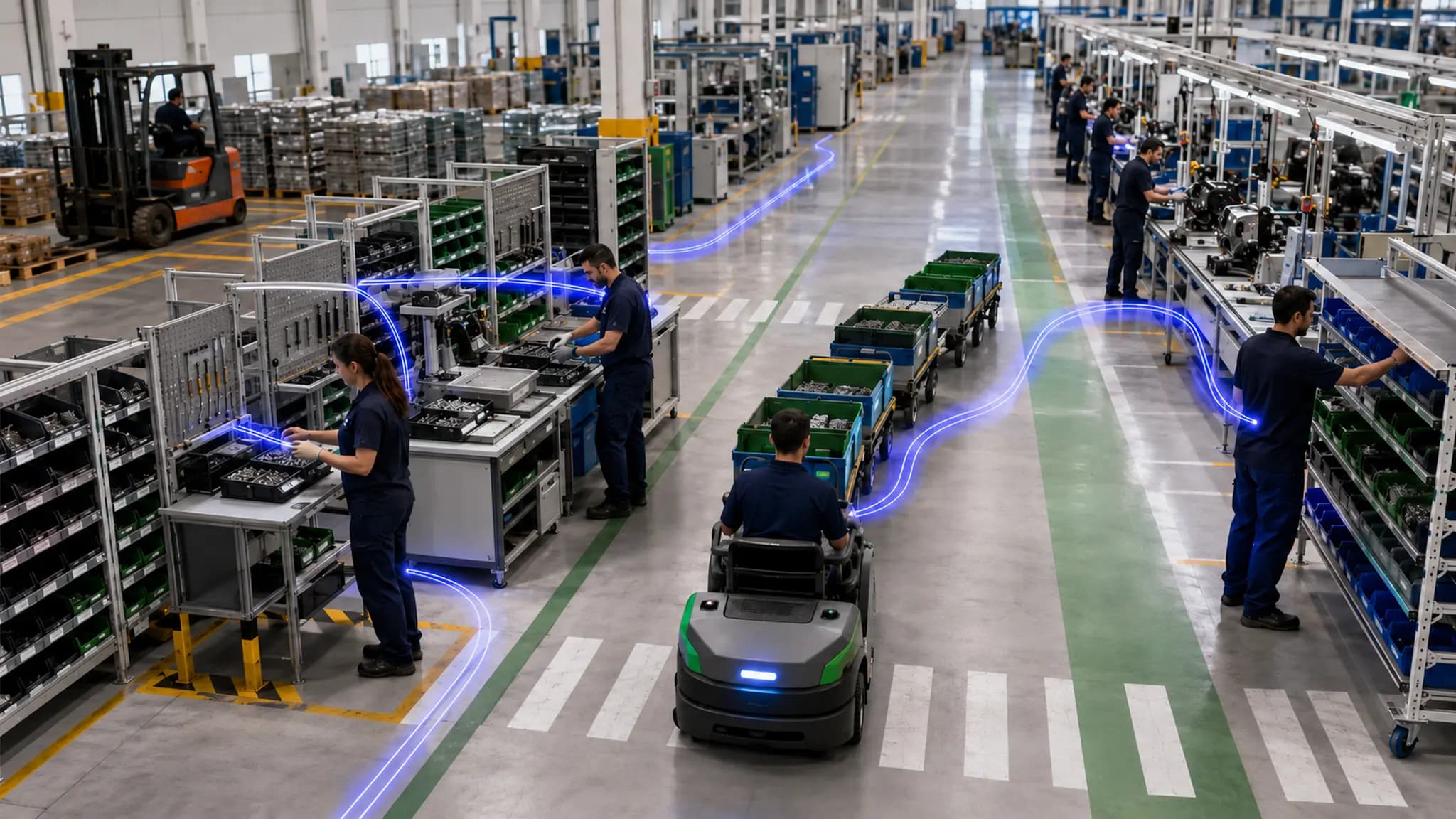
Centralise transport demand. Prepare every shipment.
Back to CANDOR TMS

CANDOR TMS · Shipper edition

Centralise transport demand.
Prepare every shipment.

Bring orders, origins, destinations, deadlines, volumes and constraints into one actionable transport request.

01 / 05Transport demand

BEFORE CANDOR

Fragmented carrier relationships

Re-entry, limited visibility, late trade-offs and scattered data slow operations.

WITH CANDOR

A controlled carrier panel

Select, contract, allocate and control every transport service through one coherent flow.

From shipment demand through service control, every decision remains connected to the order, the transport operation and its evidence.

CANDOR Shipper journey

From shipment demand through service control.

The Shipper edition structures demand, allocation rules, execution and cost reconciliation without assuming which data or connectors are available.

Business scenario: Consolidate Contextualised demand

Stage 01 · Consolidate

Qualify transport demand

Order, origin, destination, due date, quantity and constraints form an actionable requirement.

  • Transport demand. Collection, qualification, consolidation and prioritisation.
  • Consolidate. Collect and qualify transport demand before planning.
  • Ecosystem. The role of ERP is validated during scoping.
01 / 04

Decision scenarios

The situations that reveal the journey’s value.

These scenarios make the experience concrete without turning a scoping option into a contractual commitment.

Several carriers can serve one shipment

Capacity, cost and service rules make the options comparable without claiming to select the best provider automatically. Validate criteria, priority order and final responsibility.

A delay is reported

The event is connected to the shipment and affected commitment so that the next action can be prepared. Define source, threshold, recipients and alert channel.

An invoice differs from the actual service

The control traces back to the service, applicable terms and available evidence. Set tolerances, supporting documents and approval workflow.

A rate card changes during the period

The contract, its effective date and affected missions remain identifiable before reconciliation. Define version, precedence and approval rule.

Proof of delivery is missing

The shipment remains open on the expected evidence and the responsible partner can be contacted through the selected channel. Set mandatory evidence, due date, reminder and dispute handling.

The transport network must evolve

Available volumes, sites, destinations, capacity, service and costs feed a comparison of scenarios. Validate assumptions, horizon, constraints and final decision-maker.

What holds operations back

When information fragments, operations slow down.

The starting point is not software. It is difficult decisions, repeated data entry and the areas where teams lose time or confidence.

01

Scattered requests

Transport needs arrive by email, spreadsheets or calls without a consolidated view.

02

Late allocations

Capacity, rates, constraints and commitments are difficult to compare consistently.

03

Complex freight invoices

Differences between planned, executed, evidenced and invoiced services take too long to explain.

Connected operational environment
Data Flows Decisions

Expected transformation

See, orchestrate, improve.

The target system should simplify daily work, clarify responsibilities and make exceptions actionable.

01

Consolidate

Collect and qualify transport demand before planning.

02

Allocate

Compare internal resources and providers through explicit criteria and responsibilities.

03

Control

Reconcile service, events, evidence, costs and billing items.

What the solution puts into motion

Capabilities designed as a journey.

Each capability belongs to a business sequence. The final scope, modules, integrations and validation rules are defined during scoping.

01

Transport demand

Collection, qualification, consolidation and prioritisation.

View the journey
02

Planning

Consolidation, sequencing, capacity anticipation, network design and arbitration rules within the agreed scope.

View the journey
03

Providers

Panel, terms, allocations, exchanges and documented performance.

View the journey
04

Execution & evidence

Statuses, incidents, documents and POD from the selected sources.

View the journey
05

Cost & pre-billing

Reconciliation of planned service, actual service and applicable terms.

View the journey
06

Carrier portal

Orders, statuses, documents and evidence shared with providers according to their access rights.

View the journey
07

Contracts & rates

Rate cards, seasonality, insurance, penalties and special terms connected to the provider panel.

View the journey
08

Alerts & service

Thresholds, recipients and notifications configured for the selected milestones and exceptions.

View the journey
09

Transport analytics

Spend, service levels, punctuality, disputes and provider performance based on validated data.

View the journey

An experience that remains clear

From field execution to the cockpit.

Screens are built around tasks, exceptions and decisions. Illustrative data explains the experience and is not a contractual commitment.

  • Guided, contextual workflows
  • Mobility adapted to field use
  • Connected alerts, actions and history
  • Actionable analysis without decorative dashboards
Illustrative data

Reference points from the supplied CANDOR Shipper copy

Strong claims and planned devices remain visible with their evidence requirements.

These statements appeared in the supplied source. They are preserved without turning them into universal commitments; the relevant baseline, data, interfaces and rights must be documented first.

01Source claim · potential to quantify

“Millions in potential savings”

The source frames freight spend as a possible source of savings. The potential must be established from the actual spend, lanes, rates, capacity, constraints, kilometres and observation periods.

02Source wording · coverage to verify

“Omniscient real-time visibility”

The source combines end-to-end tracking, geolocation, automated alerts and shared statuses. Actual coverage depends on connected carriers, sources, rights, frequencies, events and data quality.

03Source figure · catalogue evidence required

“90% of market ERPs covered”

This figure and the native-integration wording require the actual standard-connector catalogue, with vendors, versions, flows, exchange methods and corresponding deployment references.

04Source capability · automation to scope

Automated exchanges and matching

The source includes orders, statuses, invoices, alerts and matching without re-entry. Rules, tolerances, exceptions, human approvals, responsibilities and interfaces must be defined flow by flow.

05Source placement · content required

Testimonials and case-study carousel

The planned structure includes customer testimonials and links to full case studies. Quotes, attributions, outcomes, contexts, rights and study content still need to be supplied.

Integrations & interoperability

Fits your ecosystem—according to your architecture.

Standard connectors are available. Coverage is confirmed by vendor, version and flow; complementary exchanges are defined during scoping.

B‑AGILEBusiness layer
ERP
WMS
Procurement
Finance
Carriers
EDI & API
Trust principle. APIs, events, files, EDI or databases: the choice depends on criticality, volume, security and the systems concerned. Deployment can be SaaS or on-premise.Explore our principles

A controlled path

Deploy for value, not complexity.

01

Understand

Activities, systems, friction and goals.

02

Scope

Scope, data, rules and evidence.

03

Design

Journeys, architecture and integrations.

04

Pilot

A representative site or flow.

05

Deploy

Adoption, migration and rollout.

06

Improve

Measurement, support and continuous evolution.

Frequently asked questions

Useful answers before moving forward.

An answer often depends on context. When the scope is not confirmed, we say so and propose the next useful step.

Who is CANDOR TMS Shipper designed for?

Organisations that procure or organise the transport of their goods and manage a network of transport providers.

Can we keep our current carriers?

Yes. The solution structures collaboration with the selected panel and its exchange channels within the agreed scope.

Are standard connectors available?

Yes. Scoping confirms the connector, version, covered flows and any complementary exchanges.

SaaS or on-premise?

Both deployment models are available. The architecture is selected according to project requirements.

Can we manage an internal fleet and external carriers together?

Yes. Owned, dedicated and subcontracted resources can share one operational view with distinct rules, rights and responsibilities.

Do carriers need to run CANDOR TMS themselves?

A portal or adapted exchanges can give them access to relevant orders, statuses and documents. The selected channels depend on each partner’s equipment and level of integration.

How is proof of delivery managed?

Photos, scans, signatures and reservations can be connected to the shipment from mobility, a portal or an interface according to the configured workflow and rights.

How does the financial scope integrate?

Contracts, rates, actual services, evidence and pre-billing items can feed controls or financial exchanges according to the selected connectors and approvals.

Build the right path

Your reality deserves more than a generic demonstration.

Share your context. We will prepare a discussion focused on your flows, systems and priorities.

Talk to an expert Launch Navigator